The Loading Dock Doesn't Lie: What Watching Your Container Get Packed Reveals About a Supplier
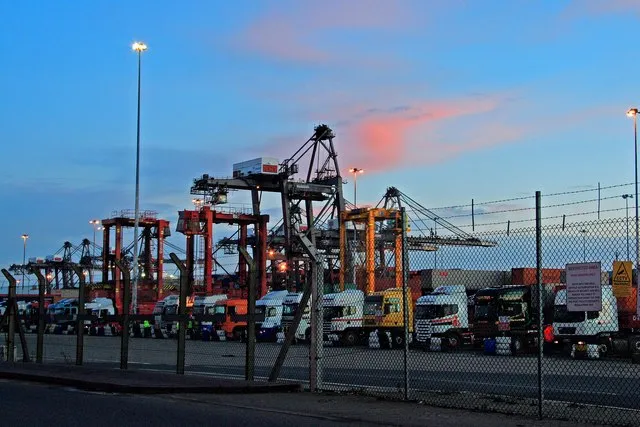
Photo: Simon Barnes, CC BY-SA 2.0, via Wikimedia Commons
There is a moment in every international transaction where the paperwork stops mattering and the truth starts showing. It happens at the loading dock. Not at the negotiation table, not in the quality report, not in the certificate folder your supplier emails as a PDF. At the dock, goods are either what you paid for or they are not — and the supplier either wants you to see them or does not.
Here in Hongseong, on Korea's west coast, a practice has quietly become part of the local export culture: suppliers invite buyers — even first-time, small-volume American importers — to watch their containers get loaded. Sometimes in person. More often by a scheduled video call at 9 p.m. Central Time, when a Chicago buyer is finishing dinner and a Hongseong foreman is starting his shift.
We would argue this single habit tells you more about a supplier than any document in their onboarding packet.
Why the Dock Is the Ultimate Audit
An ISO 9001 certificate verifies that a company has a documented process. It does not verify that the cartons going into your container this morning contain the goods you approved three weeks ago. Audits are scheduled; loading is not. When a supplier lets you watch the actual packing — the dunnage going in, the carton orientation, the pallet counts, the photos taken before the doors close — you are seeing the one moment that cannot be rehearsed.
Consider what a live loading observation reveals in under an hour:
- Carton condition and labeling. Are shipping marks correct? Is the corrugate grade what you specified, or a cheaper substitution?
- Load discipline. Are heavy cartons on the bottom? Is the container being 'floor-loaded' when you paid for palletized freight?
- Quantity verification. A worker counting cartons aloud against a packing list is worth more than a signed quantity report.
- Seal protocol. Who applies the seal, when, and is the number recorded and sent to you?
None of these details appear on a certificate. All of them appear on a video call.
The Contrast: Openness Versus Opacity
Not every sourcing region operates this way, and we say that without editorializing about any particular market. But American importers will recognize the pattern: a supplier who responds to a request to observe loading with 'we will send photos after' is asking you to trust a record they control entirely. Photos can be reused. Videos can be borrowed from another client's shipment. A live call, with your questions answered in real time — 'turn the camera to the carton label, please' — cannot be.
Opacity is not always fraud. Sometimes it is embarrassment about a messy facility, or a middleman who does not actually control the factory. But functionally, for the buyer, the outcome is the same: you are signing off on a shipment you have never seen.
The Hongseong approach inverts this. Because the region's industrial base is built on compact workshops and mid-size manufacturers rather than distant mega-facilities, the distance between 'management' and 'the loading dock' is short — often one building. When the person who answers your email can walk twenty meters and point a phone at your goods, there is no organizational barrier to transparency. Only willingness, or the lack of it.
The 'Watchability' Checklist for US Importers
Before you wire a deposit, run a supplier through this simple test. We call it the watchability assessment, and it takes less effort than a formal audit:
- Request a live loading call, not photos. Frame it as standard practice: 'We do a video call for every first shipment.' A quality supplier treats this as routine; a problem supplier treats it as an insult.
- Ask for the seal number by message, immediately after application. This is a two-minute request with a two-second cost. Hesitation is data.
- Book an unannounced-visit clause. You may never use it, but a supplier who agrees in writing to a no-notice visit during production is telling you something important about their confidence.
- Verify geography. On the video call, ask the person holding the phone to describe what is outside the window. A trading company in an office tower and a factory floor look very different at 7 a.m.
- Watch how errors are handled live. If the call reveals a short count, does the foreman correct it on camera or end the call? Real-time problem-solving is the strongest signal of all.
Transparency as a Competitive Advantage
For Hongseong's manufacturers, this openness is not charity — it is strategy. A region competing against lower-cost producers cannot win on price alone. It wins on the total confidence a buyer feels, and nothing builds confidence like nothing to hide. American importers who source through MPC Su Hongseong's partner network consistently report that the loading call became the moment they stopped worrying and started planning their next order.
Certificates belong in a folder. The loading dock belongs on your screen. Choose suppliers who understand the difference.